A fragrance bottle, and the light going through it
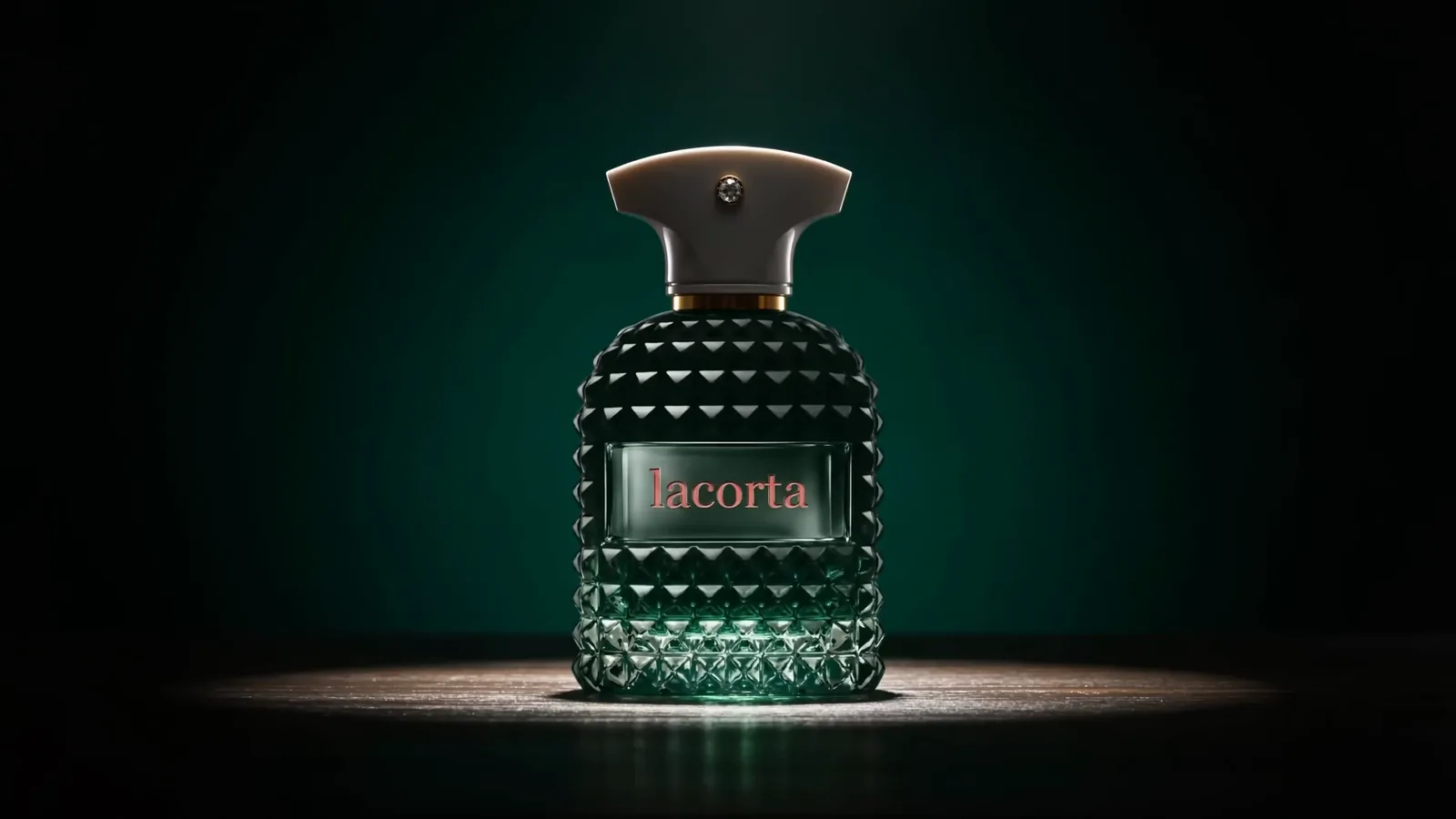
Fragrance is the hardest product category to render because almost nothing in it is opaque. This bottle is faceted glass with a coloured liquid inside, a metal collar and a stone-set cap — four different transmission and reflection problems in one object, all photographed at the macro distance the category demands.
- Discipline
- 3D product rendering and film
- Materials
- Faceted glass, tinted liquid, polished metal, cut stone
- Techniques
- Dispersion, caustics, ink simulation, volumetric lighting
- Outputs
- Hero film, print-resolution stills
Faceted glass is a caustics problem
Every facet on this bottle is a small lens. Light entering the body is refracted, bounced between internal faces and thrown back out onto the surface underneath as caustics — the bright focused patterns that pool around real glass. Most renders skip them, because caustics are expensive to compute and their absence is hard to name. The result is a bottle that looks subtly dead: correct in shape, wrong in the way it sits in the world. Rendering them properly is most of what makes this read as an object that was photographed rather than assembled.
Four materials, four different problems
- The body — faceted glass with dispersion, so edges split light rather than staying neutral
- The liquid — a tinted volume with absorption that deepens with depth, not a coloured fill
- The collar — polished metal, reflecting a set that had to exist for it to reflect
- The cap stone — a cut gem, which is the caustics problem again at a smaller scale
The film around it
The hero film cuts between a shadow cast on a plaster wall, an ink-in-water simulation, a particle sweep and the bottle itself under a hard spotlight. Those are wildly different shots that have to feel like one piece, which is a lighting continuity problem more than a compositing one: the same key direction, the same colour temperature drift, the same contrast ratio carried through cuts that share no geometry.
Why this is worth rendering rather than shooting
A fragrance shoot at this level needs a glass specialist, a black-out studio and a day of moving a single light in centimetre increments to place a highlight along one facet edge. In CG that highlight is a value you set, and it stays exactly where it was put when the art director asks to see the bottle at a different angle a week later. The bottle can also be filled with a different colour, or shot on a different surface, without any of it being rebuilt.