Food that assembles itself
Food is the category people assume CGI cannot do, because appetite appeal is subtle and everyone is an expert on what food looks like. It is also the category where CG solves something photography genuinely cannot: showing a dish assembling itself, in order, without the food collapsing, melting or browning between takes.
- Discipline
- 3D animation and rendering
- Materials
- Batter, fruit, syrup, ceramic, glass, timber
- Techniques
- Subsurface scattering, build-sequence animation
- Outputs
- Looping social animation, stills
Food is a subsurface scattering problem
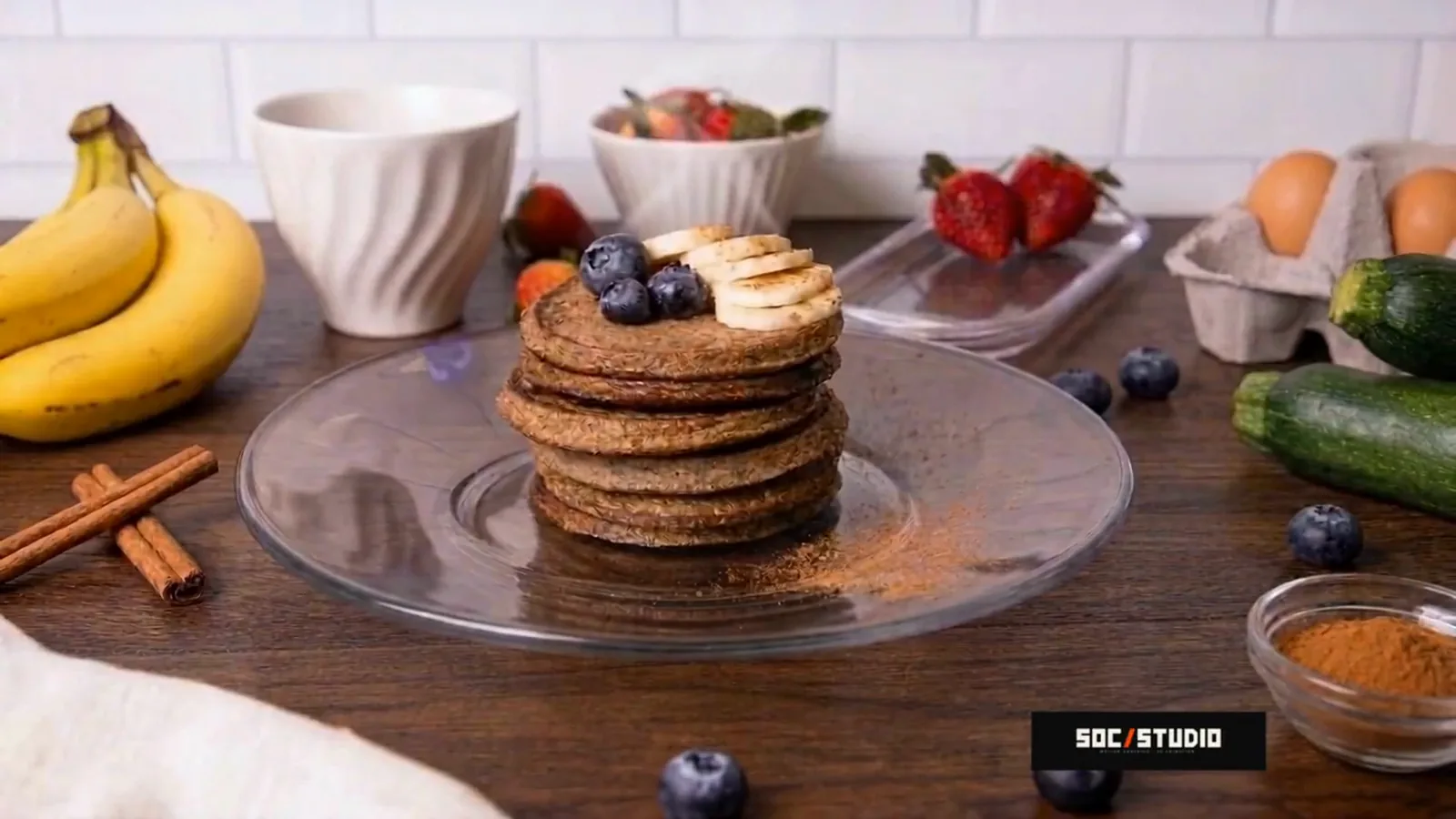
Almost nothing edible is opaque. Light enters batter, fruit flesh and syrup, bounces around inside and comes back out somewhere it did not go in — which is why a real blueberry glows slightly at its edge against a light background, and why food rendered as a solid surface looks like a plastic prop from a shop window. Every ingredient here needed its own scattering depth: a banana slice is translucent in a way a cinnamon stick is not.
The shot photography cannot take
A stack assembling itself in mid-air, in order, with every layer landing cleanly. Shot practically, that means building the stack, filming it collapsing, and reversing the footage — which works until you want a specific ingredient to arrive at a specific beat, or the food starts sagging under studio lights before the take is right. In CG the timing is a curve, and the pancake at the top of the stack looks exactly as fresh as the one at the bottom.
Why food brands render at all
- The hero portion never wilts, melts, browns or separates under lights
- Ingredient substitutions late in a campaign do not require another food stylist
- Cross-sections and pours can be art-directed rather than caught on the twentieth take
- The same dish can be re-shot months later for a seasonal variant
Where the honest limit is
Genuinely irregular, handmade food photographs better than it renders, because its appeal is in the imperfection and CG has to invent every one of those deliberately. Rendering wins where the food is consistent, the shot is impossible, or the sequence has to be controlled to a frame. It is worth saying which of those a project is before anybody quotes it.