A car is a mirror, so we built the room first
Nothing on a car body is locally shaded. Clearcoat, chrome and glass show almost nothing of themselves and almost everything of what surrounds them — so the work on an automotive render is mostly the work of building an environment worth reflecting. Once the cyclorama existed, the paint largely looked after itself.
- Discipline
- Automotive CGI
- Materials
- Two-layer clearcoat, woven carbon fibre, glass, anodised metal
- Environment
- Coloured studio cyclorama, built rather than photographed
- Outputs
- Exterior hero angles, detail crops, film
Why an empty environment ruins a good model
Put a perfectly modelled car in a grey void and it reads as a toy. Not because the geometry is wrong, but because every surface on it is a reflection of something, and there is nothing there. The horizon line, the overhead softboxes, the fall of the floor — those are what a car body actually shows you. Building them is the job. It is also why a photographic backplate is often harder than a full CG set for this kind of work: with a plate, every reflection has to be reconstructed to match a scene that was never built for the car sitting in it.
Clearcoat is two materials, not one
Automotive paint is a pigmented base with a transparent lacquer over it, and they behave differently. The base scatters colour; the clearcoat above it produces a second, sharper, colourless reflection sitting on top. Render it as a single glossy surface and the highlight goes the wrong colour — it picks up the paint instead of staying white — which is the most common tell in amateur car renders and is visible even to people who could not explain what they are seeing.
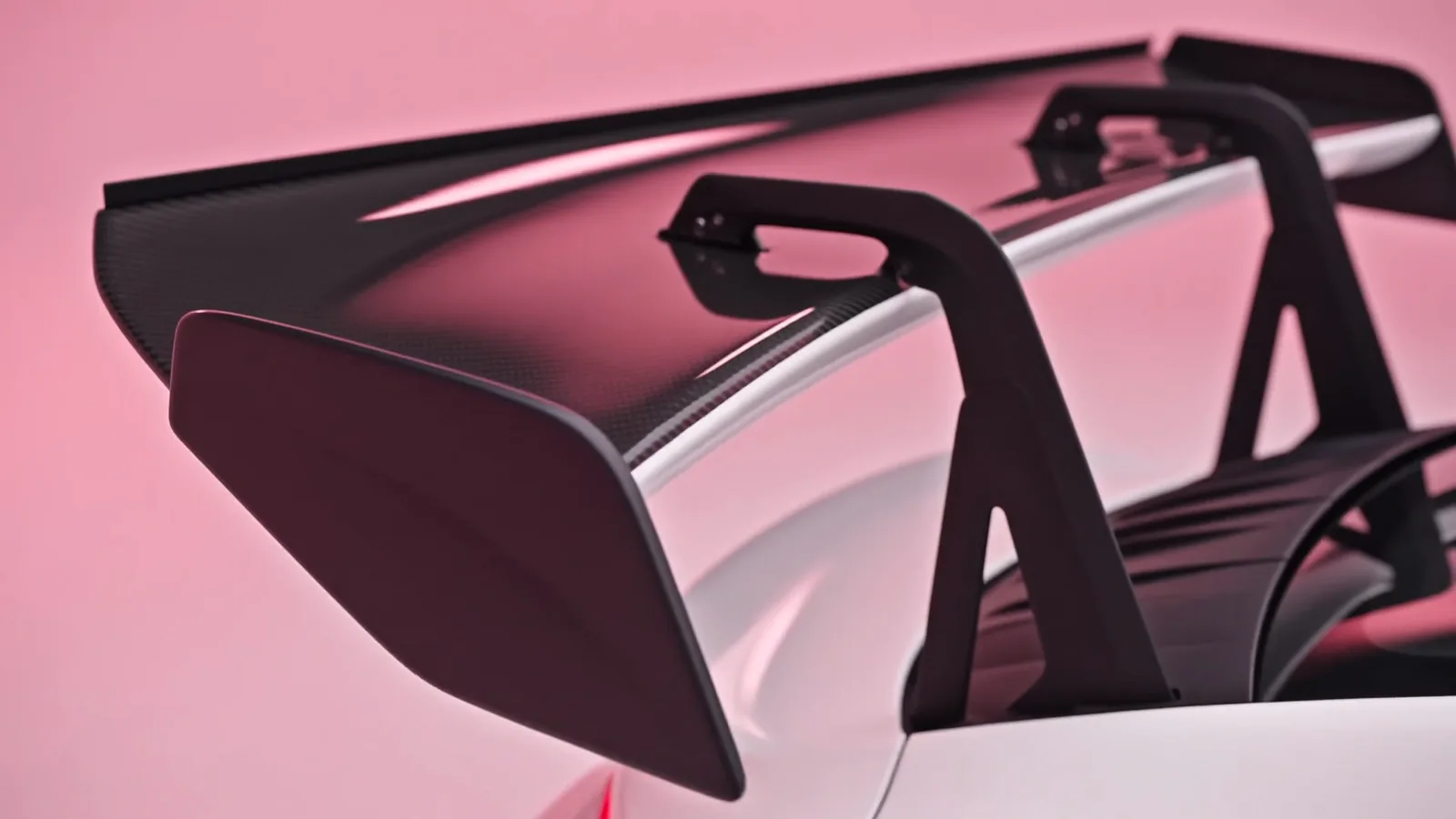
Carbon fibre at close range
- A real weave has depth: the tows pass over and under, and the lacquer sits above both
- The pattern has to follow the part, so a curved wing element is not a flat tiled texture
- Anisotropy runs along the tow direction, changing as the surface turns away
- At the distance this was shot from, a bump map fails immediately — it needs real depth
Where this pays for itself
A configurator. The point of one is that a customer can compare options, which only works if every combination is lit and framed identically — achievable by construction in CG and effectively impossible to photograph across hundreds of permutations. Build the car and the cyclorama once and the entire paint, wheel and trim matrix comes off it with no drift between options and no second shoot.